
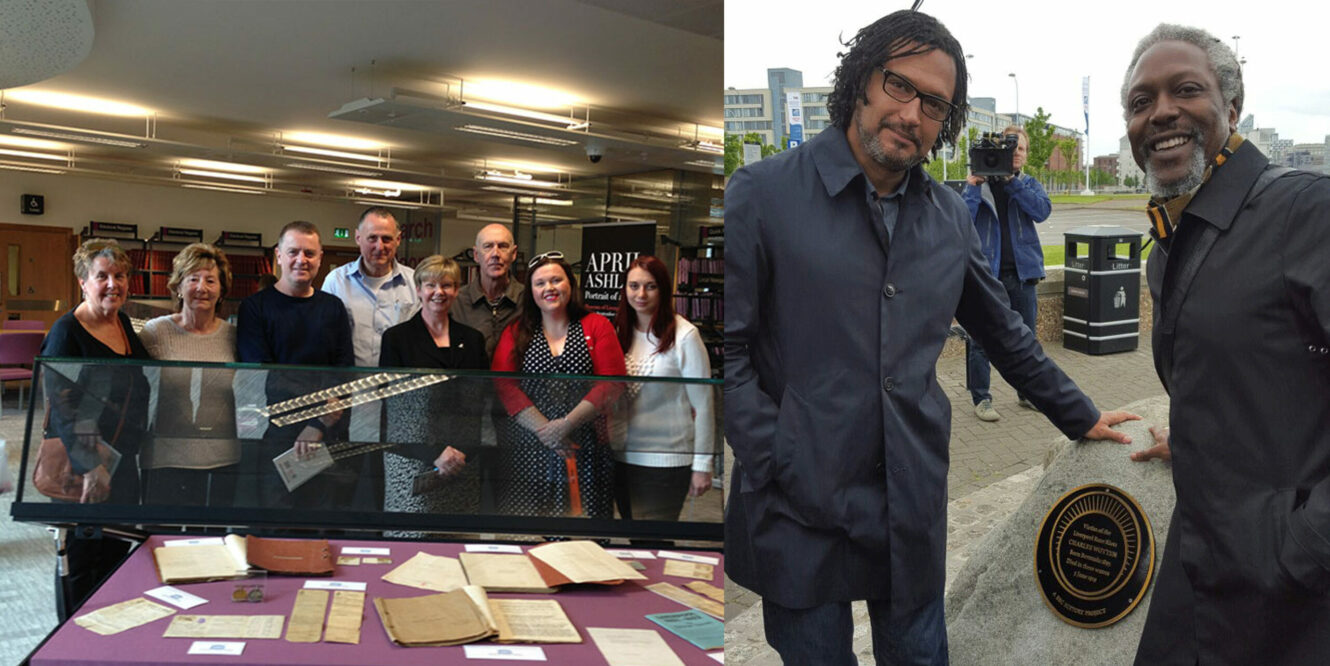
Creative Heritage is Writing on the Wall’s programme discovering and documenting hidden histories while engaging local communities in activities designed to develop their archiving skills and inspire creative work based on the stories they uncover. WoW’s unique approach to heritage encourages collaboration between a diverse group of professional archivists, academics, writers, community activists, volunteers and the public as project participants.
The George Garrett Archive Project, Great War to Race Riots, and The Liverpool 8 Law Centre Project established our our acclaimed Creative Heritage template, which, alongside other aspects, includes:
If you would like to commission Writing on the Wall to advise, consult, or deliver your archive project, email details about the project to info@writingonthewall.org.uk and we will contact you to discuss how best we can help you to achieve your aims.
The George Garrett Archive Project
The George Garrett Archive project was created by Writing on the Wall in 2013 to celebrate and preserve the legacy of the Liverpool born writer, George Garrett (1896-1966).
Garrett was a Merchant, Seaman, writer, playwright and founder member of Liverpool’s Unity Theatre. He was a radical social activist who travelled the world, living in America for a total of four years, and wrote a series of plays and short stories that led George Orwell, who he met in Liverpool while Orwell was researching ‘The Road to Wigan Pier’, to say, ‘I was very greatly impressed by Garrett. Had I known before that it is he who writes under the pseudonym of Matt Low in the Adelphi (a magazine published in the 1920’s and 30’s) and one or two other places, I would have taken steps to meet him earlier.’
Great War to Race Riots Project
In 2015 Writing on the Wall were presented with a number of original documents dating from 1919 to 1921 relating to the position of black ex-servicemen, seamen and factory workers stranded or left destitute in Liverpool after the First World War, who had fought for England on land and at sea during the Great War of 1914, or had worked in factories to support the war effort.
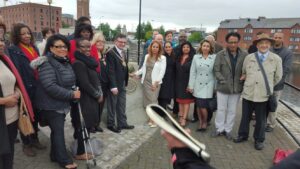
They reveal a plight of daily racism and loss of jobs because of the boycott by white workers, a boycott often supported by the trades unions. This tension led to the race riots of 1919, which resulted in many serious assaults and attacks and the death of Charles Wotten, a black seaman murdered by a white mob.
The unique nature of this material is that it contains the written word of those ex-servicemen, sailors and workers who were being confronted with verbal, physical and racial abuse on the streets of Liverpool, abuse which was compounded by institutional indifference or racism.
These archives have been collated and put together in a book which is now available to buy from Writing on the Wall’s office.
The Liverpool 8 Law Centre Archive Project
The Liverpool 8 Law Centre was one of the most significant community organisations in the city. To a community who bore the brunt of high unemployment and government spending cuts combined with institutionalised racism, it provided support, legal advice and sanctuary.
The exciting new Heritage Lottery funded L8 Archives Project will explore, collate and catalogue the collections of the Liverpool 8 law centre and other key community organisations.
The Dorothy Kuya Creative Archives Project
The Dorothy Kuya archive project, a commission awarded by National Museums Liverpool, lasted from October 2022 – August 2023. This was a highly successful project based around the archive, life and work of one of Liverpool’s most prolific antiracist campaigners. Our work drew national and international attention to the legacy of Dorothy Kuya, as well as the unique methodological approach of WoW’s Creative Heritage.

Unlock Falkner Square
Residents of Canning Ward have researched history, documented memories and shared community stories of Falkner Square in Liverpool to shape new information signage for the park.
Guest speakers have shared knowledge about Edward Falkner and his connections with slavery, how the park has been a focus for community use, and how internationally recognised culture has emerged from the neighbourhood. Residents have accessed archive materials at Liverpool Records Office and shared their own memories of living, working, playing and organising, creating a rich picture of the city of Liverpool through the lens of one of its original squares.