

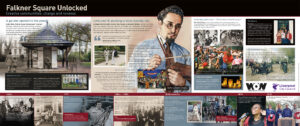
The three panels feature a timeline stretching from Liverpool’s early history as a port in the 1600s alongside featured stories uncovered by the community members through archival research and the recording of living memories. One of the three panels is dedicated to the establishment of the Black Merchant Seamen’s Memorial.
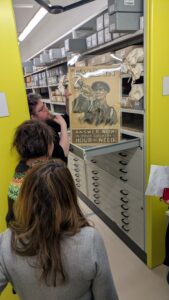 Residents of Canning Ward attended a programme of six workshops at The Deutsche Kirche Liverpool featuring guest speakers who shared knowledge about Edward Falkner and his connections with slavery, how the park has been a focus for community use, and how internationally recognised culture has emerged from the neighbourhood. Residents accessed archive materials at Liverpool Records Office and shared their own memories of living, working, playing and organising, creating a rich picture of the city of Liverpool through the lens of one of its original squares.
The resulting research was collated and designed in collaboration with Maltings Partnership, with the signs being installed in the Autumn of 2026.
Project participant Amandine Vincent took on the task of creating audio recordings with some of the speakers and fellow participants, capturing a key piece of oral history around the square. Excerpts of these recordings are available in the relevant sections on this page or check out the playlist here:
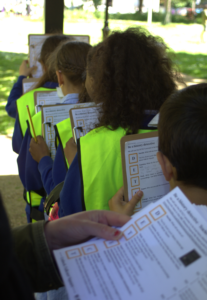 120 children from three primary schools local to Falkner Square took part in workshops at Falkner Square Gardens. The children became history detectives to discover connections to Transatlantic Slavery and why it took 50 years for a memorial to Black Merchant Seafarers to be created and placed in the park.
Using educational resources developed for this project, they took inspiration from a former resident of the square – Adrian Henri – and his ‘Poem for Liverpool 8’ that includes references to the park writing their own Henri-inspired ‘Poems for Falkner Square’.
Download the educational resource pack here, or get in touch if you would like to book Writing on the Wall to deliver a Creative heritage workshop in your educational setting.
During our programme of sessions, local residents accessed archive documents at Liverpool Records office, took advice and were presented with research from Nasra Elliot, an expert on Edward Falkner and used sources including slavevoyages.org and Gore’s directories to build a picture of the square. Writing research by the participants was edited into the information presented on the signage.
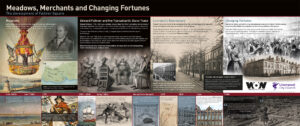
Before this area was built up in the early 19th century, it formed part of Moss Lake Fields. These open fields were a lively place for social and political gatherings, fireworks displays and public spectacles. In September 1823, a large crowd gathered here to watch James Sadler, the first English balloonist, land and then ascend again in his hot-air balloon.
Edward Falkner, 1750–1825, was a soldier, former High Sheriff of Lancashire and successful Liverpool merchant. He invested in more than 20 slave voyages, using profits from trade to buy and develop land, including this square. He originally intended it to be called Wellington Square.
Two years after Falkner’s death, in 1827, Liverpool Council voted to name the square in his honour. Between 1781 and 1808, ships in which Edward Falkner invested carried 7,402 captive Africans from the continent. Of these, 6,209 survived the forced journey across the Atlantic and disembarked in the Americas. These figures show how the history of a local square is bound up with violence across the Atlantic world.
Remembering how this wealth was made matters. It shapes how we talk about justice, repair and belonging in Liverpool today.
Falkner Square is one of three surviving early 19th-century squares in Liverpool, along with Abercromby Square and Great George Square. When Edward Falkner commissioned the square, it was not immediately popular. It stood far from the town centre, high on a hill and still surrounded by fields. Some people even nicknamed it “Falkner’s Folly”.
By around 1830, when the square was completed, it had become home to merchants, shipbuilders, shipowners, brokers, clerks, newsroom proprietors, solicitors, ministers and others. This part of Liverpool developed into a fashionable residential district, sometimes compared to London’s Bloomsbury.
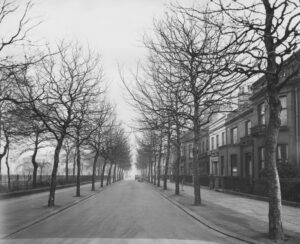
During the 1860s, economic crises including the Lancashire Cotton Famine caused many wealthy middle-class families to lose money and leave the square. From the 1890s, many of the large houses in the area were divided into smaller flats or used as nursing homes, including for wounded soldiers. During the Second World War, 1939–45, the park was used for air-raid shelters.
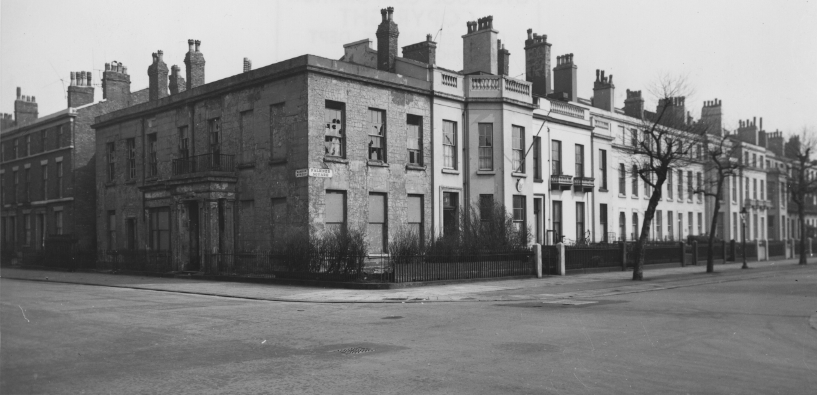
Many of the participants in our sessions had lived and worked around Falkner Square, some for all their lives. As a result, they held the keys to unlocking various pieces of the square’s history. Their oral testimonies, memories and photographs led to additional research, uncovering this rich picture of a square within a city. Visiting speakers from cultural and community organisations also added to the conversation, creating this densely detailed picture of life in Liverpool from the 1950s until today.
Housing in Liverpool is overcrowded following wartime bombing around the docks. Many people move into the area, often living in poor and overcrowded accommodation.
In the 1950s you’d get rooms in a house. There was 11 of us, really, big family. The rooms would be run by a landlord, ours was very cruel. We had a cooker that was out on the landing, but if someone hadn’t paid any rent, or he was angry with someone he would turn that cooker off anytime he felt like.
~ Sharon, local resident
Post-war rebuilding and modernisation, including the area where Liverpool Women’s Hospital now stands, leads to many buildings being demolished.
It was a bombed house, with rubble, and all the kids used to play on there. But if it wasn’t a bomb site, then it was where they were knocking the old houses down. Basically, they were knocking the community down.
~ Sharon, local resident
Listen to Sharon’s oral history about living on Falkner Square as a child in the 1950s
In the 1960s, Falkner Square Gardens was “unlocked”. No longer a private garden for key-holding residents, it became a public park with the surrounding streets watched over by stay-at-home mothers and ‘aunties’. Local people remember playing in the gardens and surrounding streets:
The ‘Cocky Watchman’ used to sit in that little hut in the middle. He looked after the park and had a little fire that he put coke in, because it was cheaper than coal — that’s where the name the Cocky Watchman came from.
~ Catherine, lifelong resident
Listen to Catherine as she recalls the Cocky Watchman in Falkner Square Park:
This area was home to many informal street economies, – public spaces are shaped by many different people, including those whose stories are often left out, particularly women.
Listen to Cathy talk about what it was like to live in an area known as the Red Light District and how the community came together to change that experience.
In the late 20th century, large houses around Falkner Square that were vacated by wealthy families became spaces for organisations supporting women, autistic people, older people and black men’s mental health, bringing care and support into the heart of Liverpool 8.
World Friendship House, 2–10 Falkner Square, once the vicar’s home and a youth club for St Saviour’s Church. Since 1989 it’s been supported living accommodation for older people, housing retired seafarers, with Chinese residents often seen practising Tai Chi in the park early in the morning.
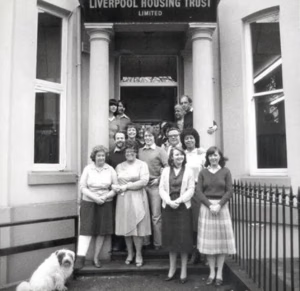
New housing associations are formed to improve living conditions, encouraged by public concern following the influential television drama Cathy Come Home. Liverpool Housing Trust is established and later opens an office at 39 Falkner Square, working to improve housing in the city.
Listen to Catherine’s oral history about living and working around Falkner Square:
During much of the 20th Century, this area was in economic decline – yet this was a time when local people built strong networks, friendships and creative lives. Affordable, if often poor-quality, housing allowed artists, writers and musicians to live and work in the area. The area’s homes, streets and public spaces were rooted in the local, yet connected internationally, helping creative culture to thrive.
“Liverpool is at the present moment the centre of the consciousness of the human universe.”
Allen Ginsberg, American poet visiting Adrian Henri in 1965
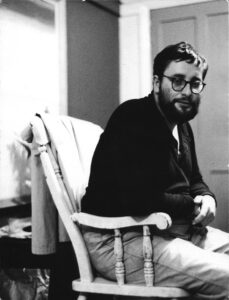
In the 1960s, Liverpool was internationally recognised for its art, poetry and music – art students John Lennon and Stuart Sutcliffe lived nearby, as did painter Sam Walsh. Adrian Henri lived at 24 Falkner Square from 1957 to 1961. A painter, poet and performance artist, Henri was pivotal in shaping a progressive avant-garde movement in Liverpool. In 1967, he was published in the best-selling poetry anthology The Mersey Sound.
With a seafaring grandfather from Mauritius who had settled in Birkenhead, Adrian Henri was part of the maritime heritage of Liverpool. His writing captures both the beauty and the everyday life of Falkner Square, a cosmopolitan neighbourhood of migrations, friendships, memory, change and creativity.
St James Rd my first home in Alan’s flat
shaken intolerable by Cathedral bells on Sundays
Falkner Sq. Gardens heaped with red leaves to kick in autumn
shuttered yellowgreen with sunlight
noisy with children’s laughter in summer
black willows into cold mist
bushes railings pillowed with snow in winter
Gambier Terrace loud Beatle guitars from the first floor
Sam painting beckoning phantoms hiding behind painted words bright colours
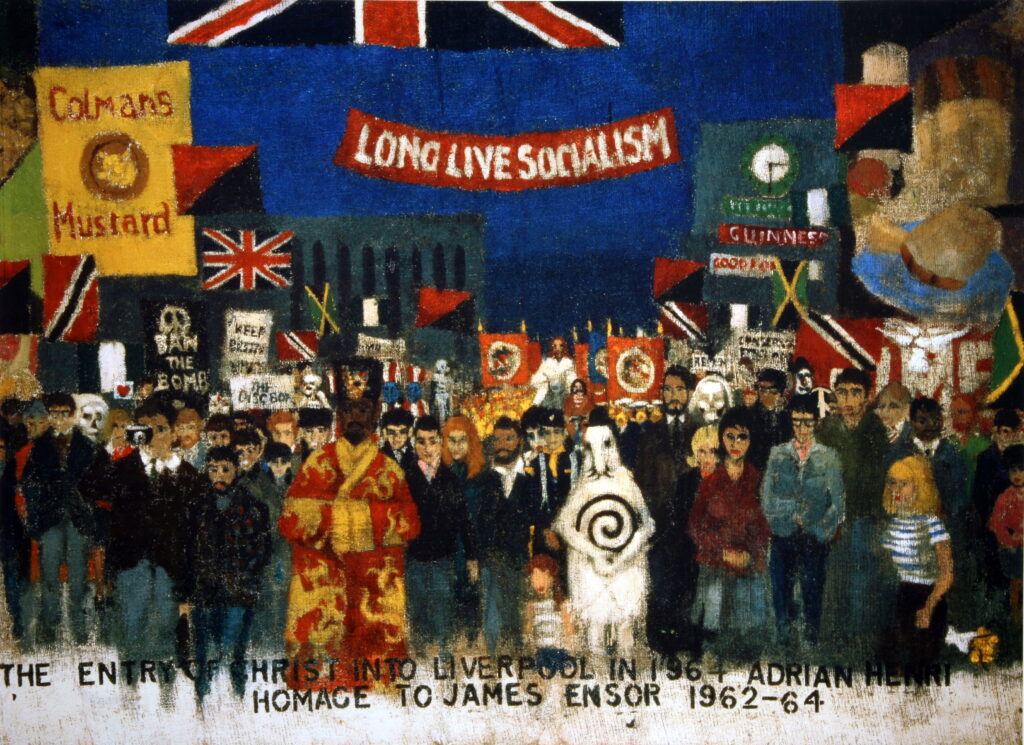
Adrian Henri images and poem by kind permission of C. Marcangeli, Adrian Henri estate, adrianhenri.com
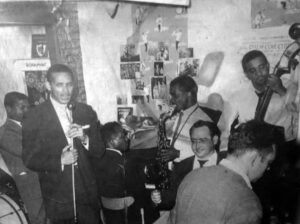
The Embassy Club operated during the 1960s-1980s from the basement of 52 Huskisson Street and formed part of a wider network of clubs in Liverpool 8 where multi-racial communities, visiting seamen and musicians helped shape the area’s distinctive music culture.
Toni “Ras T” Morgan was an artist and African drum and dance practitioner with the group Delado. He encouraged communities to claim and celebrate public spaces. Between the 1970s-1990s, Toni brought his drum to Falkner Square, sharing creative energy with everyone who joined him.
His legacy continues today through Capoeira for All, a local organisation which practices the Afro-Brazilian art form, bringing young people, music and dance into the gardens during the summer
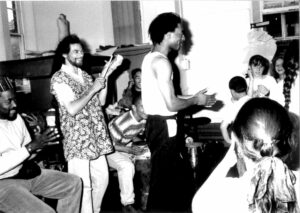
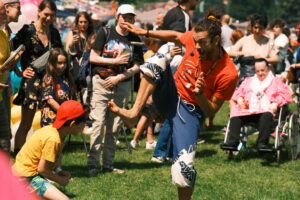
Listen to Akil Morgan talking about how his Dad, Toni, claimed Falkner Square for the community through music.
Every November, children from Deutsche Kirche Liverpool parade through the park with colourful homemade lanterns to celebrate Saint Martin before returning to the church for hot doughnuts — and glühwein for the adults.
Listen to Joy from Deutsche Kirche Liverpool talking about their Martinmas celebrations in the square
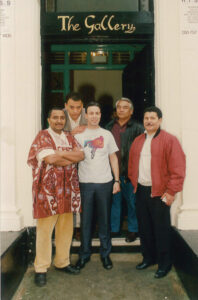
The Gallery was established as a community- based arts and cultural centre from 1991 to 1994. Located at 19 Sandon Street, on the south-west corner of Falkner Square, it was modelled on The Neighbourhood Gallery in New Orleans. Liverpool and New Orleans became twin cities in 1991, and the galleries developed an artist exchange programme. Locally, The Gallery is remembered as an active community hub where African music bands played, breakdancing lessons were held and community meetings happened.
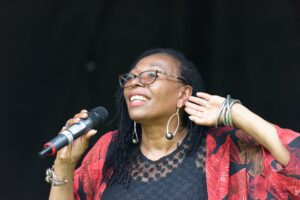
In 2018 a National Windrush Celebration Day is established. Liverpool’s First Windrush Celebration was held in Falkner Square featuring celebrated artists including poet Levi Tafari and Caroll Thompson, a ‘Queen of Lovers Rock’.
Falkner Square and the surrounding Georgian Quarter have become important locations for television and film. Liverpool Film Office supports productions in the city while balancing filming with the needs of residents. Streets are often cleared of cars, and period dramas require careful set dressing
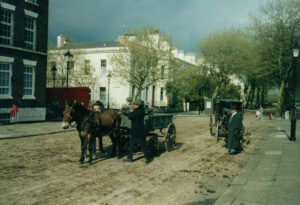
2002 ~ The Forsyte Saga: Following investment in the area, Falkner Square could convincingly stand in for Victorian London.
2014 ~ Peaky Blinders: Falkner Square became the backdrop for a dramatic bomb explosion scene set in London’s Belgravia.
2016 ~ Victoria: A procession of horses carried Queen Victoria along Canning Street and into Falkner Square Gardens, representing her visit to Crystal Palace.
2022 ~ Outlander: For the seventh season, this area was transformed into 1770s Philadelphia.
Listen to Kevin Bell from Liverpool Film Office talk about some of the productions that have been filmed in the square
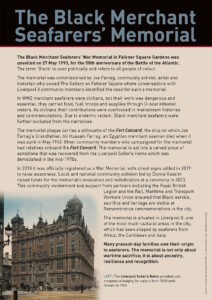 The Black Merchant Seafarers’ War Memorial in Falkner Square Gardens was unveiled on 27 May 1993, for the 50th anniversary of the Battle of the Atlantic. The term ‘Black’ is used politically and refers to all people of colour.
The memorial was commissioned by Joe Farrag, community activist, artist and historian who owned The Gallery on Falkner Square where conversations with Liverpool 8 community members identified the need for such a memorial.
In WW2 merchant seafarers were civilians, but their work was dangerous and essential: they carried food, fuel, troops and supplies through U-boat infested waters. As civilians their contributions were overlooked in mainstream histories and commemorations. Due to endemic racism, Black merchant seafarers were further excluded from the narratives.
The memorial plaque carries a silhouette of the Fort Concord, the ship on which Joe Farrag’s Grandfather, Ali Hussain Farrag, an Egyptian merchant seaman died when it was sunk in May 1943. Other community members who campaigned for the memorial had relatives onboard the Fort Concord. The memorial is set into a carved piece of sandstone that was recovered from the Liverpool Sailor’s Home which was demolished in the mid-1970s.
In 2018 it was officially registered as a War Memorial, with street signs added in 2019 to raise awareness. Local and national community activism led by Donna Kassim raised funds for the memorial’s renovation and rededication at a ceremony in 2023. This community involvement and support from partners including the Royal British Legion and the Rail, Maritime and Transport Workers Union ensured that Black service, sacrifice and heritage are visible at Remembrance commemorations in the city.
The memorial is situated in Liverpool 8, one of the most multi-cultural areas in the city, which has been shaped by seafarers from Africa, the Caribbean and Asia.
Many present-day families owe their origin to seafarers. The memorial is not only about wartime sacrifice; it is about ancestry, resilience and recognition.
Listen to Joe Farrag talk about the establishment of the memorial
Our Creative Heritage process puts the knowledge and skills of our community at the centre – it is their own experiences, memories and drive to research their city that results in such a rich picture of our shared histories. Here’s what they had to say about the project:
‘Lovely listening to all the individual stories about the square, I have lived here 28 years and am learning more about the area.’
‘Wonderful in-depth info and really fascinating personal stories.’
‘It’s quite remarkable how people come together and share relevant information. It’s a bit of an art to knit available information into an intelligible text.’
‘It’s been interesting to learn about the history of the square. Beneficial for the community to be involved in [creating] the signage’
Thank you to everyone who contributed to the project; our community researchers Catherine, Leonora, Debora, Waltraud, Lucy, Amandine, Drahoslava, Jenna, Miles, Carol, Joy, Julie, Sylvia, Rose, Sharon, Christine and Bob; guest speakers Nasra Elliot, Akil Morgan, Joe Farrag, Kevin Bell and Sam Jones; Catherine Marcangeli, Adrian Henri Estate; Donna Kassim; the team at Liverpool Records office; Amandine Vincent for Oral History audio recordings; Keith Altena at Liverpool City Council; Mike Foster and the team at Maltings Studio; Deutsche Kirche Liverpool; Pleasant Street Primary School, St Anne’s Catholic Primary School, Smithdown Primary School.
If you’re interested in working with Writing on the Wall to deliver a project using our Creative Heritage model, please get in touch info@writingonthewall.org.uk